
Group vs Private Dolpo Trek: Which is Better?
If you've searched private vs group trek in nepal before, most of what comes up is written for Everest or Annapurna: trails with teahouses every hour, daily group departures, and a support system built for high trekker volume. Dolpo doesn't work that way.
There's no strip of lodges to fall back on above Ringmo. Every group, whether it's six people or one, needs its own cook, kitchen crew, and porters carrying tents from Juphal onward. And until recently, a "private Dolpo trek" for a solo traveler wasn't even something we could legally offer, since Nepal's restricted area rules required a minimum of two trekkers per permit.
That changed in March 2026. As a Dolpo based operator run by people from Phoksundo, we're writing this to walk you through what group vs private Dolpo trek actually means today: the real cost difference, how the Phoksundo Lake experience differs between the two, and which one fits your trip. If you're weighing a group trek vs private trek dolpo decision for the first time, the permit changes alone make this a very different conversation than it was a year ago.
What Is a Group Dolpo Trek?
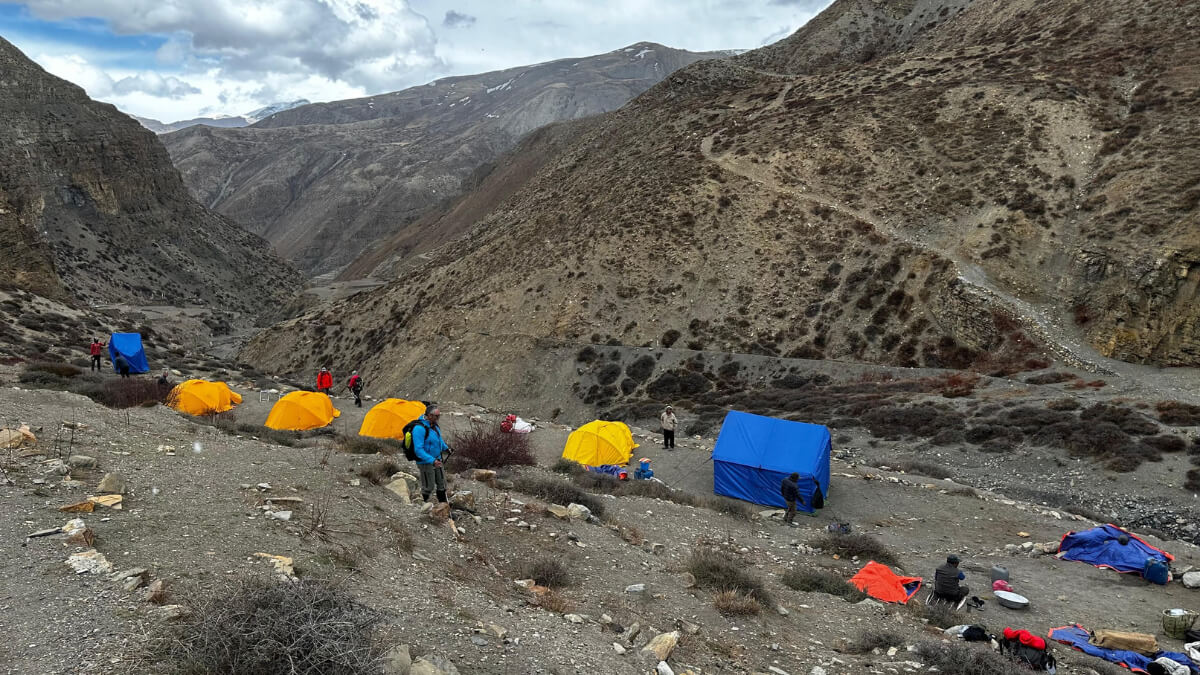
A group Dolpo trek means joining a fixed departure with other trekkers, sharing one guide, one cook, and one porter and kitchen crew between everyone on the trip. Costs for that shared crew, camping equipment, and transport are split across the group, which is where most of the savings come from.
Group sizes in Dolpo tend to run smaller than what you'd see on Everest or Annapurna group departures. The terrain, the camping logistics, and the remoteness naturally cap how large a group can comfortably move together. Our own Upper Dolpo Trek, for example, is set up for small groups rather than large tour bus parties.
Group departures work well for:
♦ Upper Dolpo Trek (25 Days): long and expedition style, benefits from shared crew costs over three plus weeks
♦ Mugu Dolpo Trek via GHT (27 Days): same logic, even longer route
♦ Beni Dolpo Trek via Dhorpatan (26 Days)
What Is a Private Dolpo Trek?
A private Dolpo trek means your own guide, your own crew, and an itinerary built around your dates, your pace, and your interests, not a fixed departure calendar.
What changed in 2026: until this year, Nepal's restricted area permit rules required a minimum of two foreign trekkers before an agency could even apply for your Restricted Area Permit. Solo travelers had to either find a second trekker or pay for an empty second permit. As of the March 2026 reform, that minimum group requirement has been removed. A solo trekker can now get a Dolpo Restricted Area Permit without needing a second person.
What hasn't changed: a licensed guide through a registered trekking agency is still mandatory for Upper and Lower Dolpo, group or private. Independent, guideless trekking in restricted areas remains prohibited.
One thing worth being upfront about: "private" in Dolpo doesn't mean lighter logistics. Because there are no teahouses to rely on for most of the route, even a private trek for one person still needs a full camping crew: cook, kitchen staff, and porters or mules to carry tents and supplies. That's different from a private teahouse trek in Annapurna, where a solo trekker with one guide can genuinely travel light.
Dolpo Trekking Permits: Group vs Private (2026 Rules)
Permit costs in Dolpo are fixed by the Nepal government per person. They don't change whether you're trekking in a group or privately. Here's what's currently required, based on our own Upper Dolpo Trek permit breakdown:
| Permit | Fee | Notes |
| Upper Dolpo Restricted Area Permit (RAP) | USD 500/person for first 10 days, then USD 50/person/day | Required to enter Upper Dolpo's restricted zones |
| Lower Dolpo Restricted Area Permit | USD 20/person/week, then USD 5/person/day | Needed if your route passes through Lower Dolpo en route to or from Upper Dolpo |
| Shey Phoksundo National Park Permit | USD 30/person | Covers Phoksundo Lake and the surrounding national park area |
| TIMS Card | USD 10 to 20 | Usually included by the agency; optional in restricted areas |
Because these fees are per person and set by the government, there's no "group rate" on permits themselves. The cost difference between group and private treks in Dolpo comes almost entirely from how the crew and camping costs are shared, not from the permits.
One practical note for private trekkers: since the Upper Dolpo permit jumps to a per day rate after the first 10 days, a private itinerary that's easy to shorten or extend on request will directly move your permit total up or down, something a fixed group departure doesn't offer.
Group vs Private Dolpo Trek Cost
Group treks split the fixed costs of a cook, kitchen crew, porters, and camping gear across everyone on the trip, so per person cost drops as the group grows, up to a practical limit. Private treks carry that same full crew requirement for one or two people, so the cost per person is naturally higher.
As a reference point, here's what our current group joining Dolpo packages start from:
♦ Upper Dolpo Trek (25 Days): from USD 3,900
♦ Lower Dolpo Trek (18 Days): from USD 2,800
♦ Mugu Dolpo Trek via GHT (27 Days): from USD 4,500
♦ Beni Dolpo Trek via Dhorpatan (26 Days): from USD 3,600
♦ Phoksundo Lake Tea House Trek (12 Days): from USD 1,900
♦ Phoksundo Bon Cultural Trek (12 Days): from USD 2,000
These are group joining starting prices. A private version of the same itinerary will cost more per person, since the crew size stays largely the same, whether it's carrying gear for two people or twelve. The gap between group and private pricing tends to be wider here than on teahouse routes like Everest or Annapurna, precisely because Dolpo's camping based logistics don't scale down.
Not sure which one fits your budget? Talk to us and we'll help you work out the numbers for your trip.
Group vs Private Dolpo Trek Phoksundo Lake Experience
Phoksundo Lake is the centerpiece of nearly every Dolpo itinerary, and it's where a group vs private dolpo trek phoksundo lake comparison is easiest to feel.
On a group trek: you arrive at Ringmo with everyone else on a shared schedule, camp together on the lakeshore, and typically get one built in rest day to explore the Bon monastery above the lake and acclimatize. It's a naturally social stop, with evenings around the kitchen tent and shared stories after a long trekking day.
On a private trek: you can decide how long to stay. Some of our private trekkers add an extra night at Phoksundo for photography around sunrise, when the water is at its calmest, or to explore Ringmo village and the Bon monastery at their own pace rather than on a shared timetable. It also makes it easier to combine the lake with our Phoksundo Bon Cultural Trek route if the Bon religious sites are a specific interest.
Neither version is "better" here. It depends on whether you want the lake to be one stop among a shared group experience, or a place you can genuinely slow down in on your own terms.
Camping and Logistics: Why Dolpo Isn't a Teahouse Trek
This is the point most generic "group vs private Nepal trekking" articles miss, because they're written with Everest or Annapurna in mind. Most of the Upper Dolpo route, and long stretches of Lower Dolpo, have no teahouses at all. Camping is the only option, not a fallback.
That means the comparison people are used to making for other regions, that private means lighter and more flexible logistics, doesn't fully hold here. Whether you're one trekker or a group of eight, you need tents, a kitchen crew, and porters or mules carrying supplies for the full duration. Private trekking in Dolpo buys you flexibility in pace, dates, and itinerary. It doesn't buy you a lighter operation.
Safety, Guides and Crew in Remote Dolpo
A licensed guide is mandatory for safety in Dolpo regardless of whether you trek in a group or privately, and that hasn't changed with the 2026 reform. What matters more here than almost anywhere else in Nepal is how well that guide actually knows the terrain, since rescue and communication infrastructure above Ringmo is limited compared to Everest or Annapurna.
This is where we'd make the case for choosing an operator focused specifically on Dolpo: our guides are from Dolpo and Phoksundo themselves, not guides based in Kathmandu who occasionally lead a Dolpo trip. That local knowledge of weather patterns, river crossings, altitude pacing, and the villages along the way matters for both group and private trekkers, but it matters most when something goes wrong far from the nearest airstrip.
Which Should You Choose: Group or Private Dolpo Trek?
Deciding on a group trek vs private trek in dolpo really comes down to your budget, your dates, and how much you value flexibility over shared cost savings.
♦ Budget conscious travelers who don't mind a fixed schedule: group trek. Shared crew costs bring the per person price down meaningfully over an 18 to 27 day itinerary.
♦ Couples and families wanting flexibility on pace and rest days: private trek, especially for shorter routes like the Phoksundo Lake Tea House Trek or Phoksundo Bon Cultural Trek.
♦ Photographers and travelers with specific interests (Bon monasteries, extra time at Phoksundo Lake, custom routing): private trek.
♦ First time trekkers to multi week camping expeditions at altitude: group trek. Shared pacing and the presence of other trekkers can make the first long camping expedition feel less isolating.
♦ Solo travelers now that the two person permit rule is gone: private trekking is genuinely open to you for the first time, though joining a scheduled group departure remains the cheaper option if your dates are flexible.
Trek Dolpo With People Who Call It Home
Whichever way you go, group or private, the decision ultimately comes down to your budget, your dates, and how you want to spend your time in Dolpo. We at Dolpo Caravan Treks can help either way. Our guides grew up in Dolpo and Phoksundo, so the trails, the passes, and the villages along the way aren't just a route on a map to us. They're home.
If you're still weighing group vs private Dolpo trek options for your trip, tell us your dates and what matters most to you, and we'll help you figure out which one actually fits. Contact us to get started.
FAQs
How do I decide on a private vs group dolpo trek?
It comes down to budget, flexibility, and how comfortable you are with a fixed schedule. A private trek vs group trek dolpo choice usually favors group joining if cost matters most, and private trekking if pace, dates, and customization matter more.
Can I do a private or solo Dolpo trek in 2026?
Yes. Since the March 2026 reform, Nepal no longer requires a minimum of two trekkers for restricted area permits, including Dolpo. Solo trekkers can now obtain a Dolpo Restricted Area Permit on their own.
Do I still need a guide for a private Dolpo trek?
Yes. A licensed guide through a registered trekking agency remains mandatory for both Upper and Lower Dolpo, regardless of group size. This requirement was not affected by the 2026 reform.
Is a group Dolpo trek cheaper than a private one?
Generally, yes. Permit fees are fixed per person either way, but group treks split the cost of the camping crew, equipment, and logistics across more people, lowering the per person price.
Is camping mandatory in Dolpo, even on a private trek?
For most of Upper Dolpo and long stretches of Lower Dolpo, yes. There are no teahouses to fall back on, so a full camping crew is required whether you're trekking privately or in a group.
Can families or couples do a private Phoksundo Lake trek?
Yes. Shorter itineraries like the Phoksundo Lake Tea House Trek or Phoksundo Bon Cultural Trek work well as private trips for couples and families wanting a more flexible, less physically demanding introduction to Dolpo.

Leave Your Comment